How Many Wheels Are in the World?
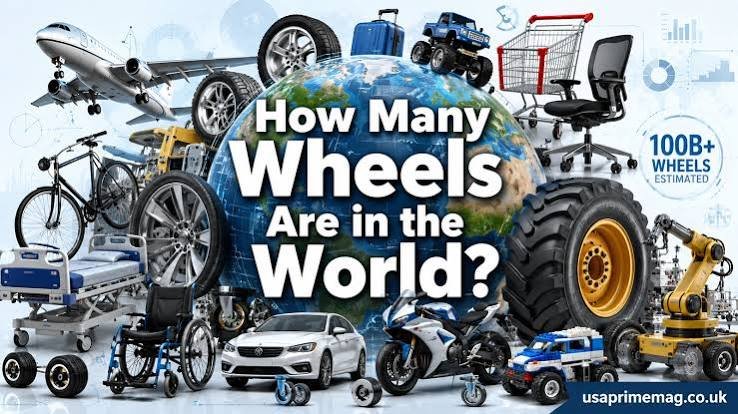
Have you ever wondered how many wheels are in the world? It sounds like a simple question, but finding an exact answer is surprisingly difficult. Wheels are everywhere, from cars, bicycles, motorcycles, trucks, and buses to office chairs, toys, luggage, carts, industrial equipment, and machinery.
There is no global registry that counts every wheel individually. Instead, researchers and curious observers have to estimate the total by examining the number of vehicles and other wheeled objects around the world. Because the answer depends on what qualifies as a wheel, any worldwide figure should be treated as an estimate rather than a precise count.
How Many Wheels Are in the World? Understanding the Estimate
When asking how many wheels are in the world, vehicles provide the most obvious starting point. There are well over a billion motor vehicles in use globally, according to international transportation statistics and industry estimates.
A typical passenger car has four road wheels, although it may also have a spare tire. Trucks, buses, trailers, and specialized vehicles can have considerably more. Motorcycles generally have two wheels, while bicycles add hundreds of millions more to the global total.
This means road vehicles alone account for several billion wheels. Once bicycles, scooters, trailers, agricultural machines, and other transportation equipment are included, the number becomes substantially larger.
The International Organization of Motor Vehicle Manufacturers provides useful global data on vehicles in use, helping illustrate the enormous scale of transportation worldwide.
Cars and Trucks Make Up a Huge Share
Passenger vehicles are likely one of the largest contributors to the worldwide wheel count. A conventional car typically has four wheels, meaning even hundreds of millions of cars translate into billions of individual wheels.
Commercial trucks can contribute even more because many have six, eight, ten, or more wheels depending on their design. Trailers add another significant category because they contain wheels independently of the vehicle pulling them.
Therefore, any serious attempt to calculate how many wheels are in the world needs to consider both vehicles and their trailers. Simply multiplying the number of cars by four would produce a useful starting estimate but would leave out many important sources.
Bicycles Add Hundreds of Millions of Wheels
Bicycles are another major part of the calculation. Millions of people use bicycles for transportation, recreation, exercise, and work.
Unlike cars, most bicycles have only two wheels. However, their enormous global population means they can make a meaningful contribution to the overall number.
Children’s bicycles, mountain bikes, road bikes, electric bicycles, cargo bikes, and other specialized models all contribute to the total. The International Energy Agency has also documented the rapid growth of electric two- and three-wheelers in many parts of the world. (IEA)
What About Wheels on Everyday Objects?
The question becomes much more interesting when we move beyond transportation.
Think about an office chair. Many chairs have five casters. Shopping carts commonly have four wheels. Suitcases often have two or four. Dollies, wheelbarrows, skateboards, strollers, bicycles, toys, and material-handling equipment can contain anywhere from one to dozens of wheels.
This makes how many wheels are in the world almost impossible to answer precisely. There are billions of wheeled objects that are not registered, tracked, or counted in transportation databases.
Toys alone could dramatically change the estimate. A toy car with four wheels is still a set of four wheels, even though it contributes nothing to transportation statistics.
Industrial Machines Could Push the Number Even Higher
Factories, warehouses, farms, construction sites, airports, and shipping facilities use countless wheeled machines and equipment.
Forklifts, carts, conveyor systems, agricultural machinery, aircraft ground equipment, robotic platforms, and other industrial devices can contain multiple wheels or rollers. Some machines use specialized wheel systems that are not immediately recognizable as traditional wheels.
Because these items are spread across countless businesses and countries, there is no practical worldwide database for counting them individually.
For related information, see our guide to global transportation statistics.
Why There Is No Exact Global Number
So, how many wheels are in the world? The honest answer is that nobody knows the exact number.
The challenge is not simply a lack of data. The definition of a wheel itself creates problems. Should a roller on industrial equipment count? What about a caster? Should spare tires count? What about toy wheels sitting in warehouses? Should wheels belonging to abandoned vehicles be included?
Different definitions produce dramatically different totals.
A reasonable broad estimate could place the number of wheels in the tens of billions, particularly when vehicles, bicycles, toys, furniture, carts, luggage, and industrial equipment are considered together. However, this should be understood as an approximation rather than an officially verified global statistic.
Wheels vs. Doors: Why the Question Is So Popular
The question of how many wheels are in the world is often discussed alongside the playful debate about whether there are more wheels or doors.
The appeal comes from the fact that wheels appear in an enormous variety of objects. Doors are relatively easy to recognize, while wheels can be hidden inside toys, machinery, furniture, transportation equipment, and other products.
There is no universally accepted answer to the wheels-versus-doors debate. Instead, it demonstrates how difficult seemingly simple global counting questions can become when categories are broad and definitions vary.
Frequently Asked Questions
How many wheels are estimated to be in the world?
There is no official worldwide count, but a broad estimate can reasonably reach tens of billions when transportation, toys, furniture, carts, luggage, and industrial equipment are included.
How many wheels does the average car have?
Most standard passenger cars have four road wheels. Some also carry a spare tire, while specialized vehicles may have more.
Are bicycles included when counting the world’s wheels?
Yes. Bicycles generally have two wheels, and the enormous number of bicycles worldwide makes them an important part of any estimate.
Do toy wheels count?
They can, depending on the definition being used. Including toys, office chairs, carts, and other everyday objects makes the estimated total considerably larger.
Will we ever know the exact number?
Probably not. The global number constantly changes as vehicles and products are manufactured, sold, scrapped, repaired, and replaced.
Conclusion
So, how many wheels are in the world? There is no single confirmed figure, but the answer is almost certainly measured in the tens of billions when all major categories are considered.
Cars and trucks provide billions of wheels, while bicycles, motorcycles, trailers, office chairs, luggage, shopping carts, toys, and industrial equipment add countless more. The lack of a universal definition and global wheel-counting system makes an exact answer impossible.
What makes the question fascinating is precisely that complexity. Something as ordinary as a wheel exists in an astonishing variety of objects, making the world’s total far larger than most people initially imagine.